
Overview
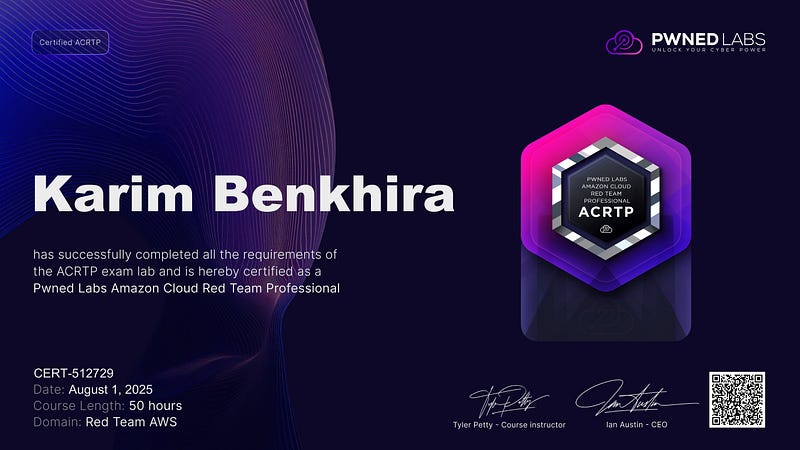
Completing the Amazon Cloud Red Team Professional (ACRTP) certification from Pwned Labs, alongside its Electra and ThunderDome cyber ranges, gave me a more practical understanding of cloud security.
The value was not just learning individual techniques. It was learning to connect identities, permissions, workloads, and defensive telemetry into a coherent picture of an environment. Structured training introduced the concepts; the ranges challenged me to apply them without a step-by-step guide.
This is a reflection on my 2025 learning experience, including what challenged me, what changed my approach, and which lessons I want to carry into future security work.
| Experience | Cloud focus | What it added to my learning |
|---|---|---|
| ACRTP bootcamp and exam | AWS | A structured foundation in cloud attack paths and defensive analysis |
| Electra | AWS | Applying skills in a simulated company environment |
| ThunderDome | AWS, Azure, and GCP | Reasoning about identity and trust across cloud boundaries |
The ACRTP bootcamp experience
Session 1 — Initial access and the external attack surface
The first session approached AWS fundamentals from an adversarial perspective. Instead of asking only how a service should be deployed, I learned to ask what an external observer could discover and which assumptions might fail.
The topics that stood out were:
- Account and identity enumeration. Mapping account context and exposed identities helped organize the attack surface. Finding an identifier was a starting point for investigation, not proof of access.
- Exposed credentials and secret handling. Studying AMBERSQUID-related tradecraft connected the training to real-world cloud threats and reinforced the importance of protecting credentials.
- Internal and external user discovery. Understanding how services reveal information about identities made access controls and monitoring feel much more concrete.
The main lesson was to build a picture of the environment before jumping to an exploitation hypothesis.
Session 2 — IAM exploitation and trust relationships
IAM was the most transformative part of the bootcamp for me. It changed how I thought about both offensive testing and defensive architecture.
Overprivileged policies showed why broad permissions deserve careful review. A policy can look routine in isolation while creating a dangerous path when combined with other permissions or trust relationships.
Role trust policies and OpenID Connect pushed me to examine who could assume an identity, under which conditions, and with which resulting permissions. Authentication alone was not enough to understand the security boundary.
Attack-path visualization helped connect these observations. Mapping the relationships between principals, roles, and resources made it easier to explain why a path mattered and where a defender could interrupt it.
Session 3 — Resource-level attacks and visibility
The next stage connected identity to the resources it could reach:
- S3: moving beyond bucket discovery to understanding access, exposed data, and the consequences of leaked credentials.
- EC2 instance metadata: examining how an application weakness could expose a workload’s temporary role credentials.
- Containerized workloads: using SCARLETEEL-related scenarios to think about exposed services and workload permissions.
- CloudTrail and GuardDuty: considering how offensive activity might appear to defenders and where visibility depended on configuration.
One distinction mattered throughout: access to instance-role credentials gives the permissions associated with that role; it does not automatically imply full control of an AWS account. The role’s effective permissions determine the next boundary. AWS documentation on instance-role credentials
Session 4 — Bringing offense and defense together
The purple-team perspective tied the earlier sessions together. I had to think about how an attack unfolded and how a defender could recognize and contain it.
Incident response, honey tokens, and defensive traps added a different set of questions: what would provide an early warning, which evidence would be useful, and which controls would reduce the impact?
The capstone CTF brought those ideas back into a practical exercise. It reinforced that understanding a technique is different from applying it methodically in an unfamiliar environment.
The ACRTP certification exam
The exam I took was a 24-hour practical challenge. It tested not only technical knowledge, but also persistence, prioritization, and the ability to keep a clear methodology under pressure.
The bootcamp gave me a foundation, but the exam required me to connect the pieces. I found that careful enumeration, clear notes, and revisiting assumptions were just as important as recognizing an individual technique.
Completing it was a rewarding milestone in my cloud red-teaming journey. The experience made the relationship between attack paths and defensive controls much more tangible.
Pwned Labs cyber ranges
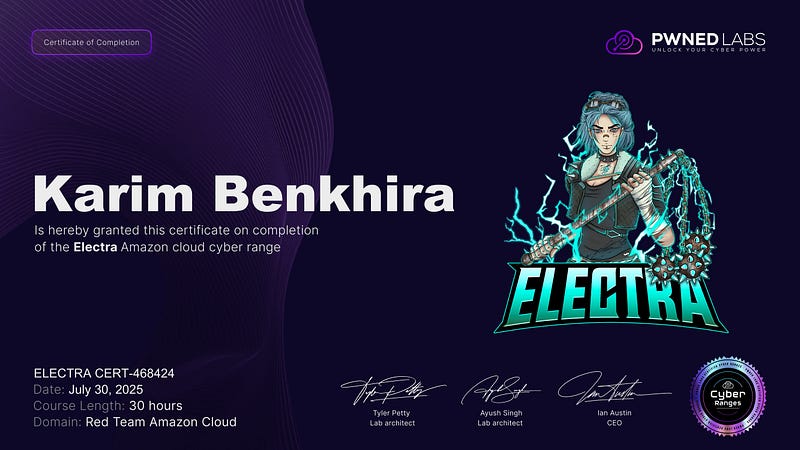
Electra — Applying the AWS foundation
Electra gave me an intermediate-level challenge in a simulated AWS company environment. In my experience, its electric-vehicle company scenario made the work feel connected rather than like a collection of isolated exercises.
Starting from an external perspective reinforced the importance of reconnaissance. I also became more comfortable reasoning about the relationship between a web application and its cloud environment: an application does not exist separately from its workload identity, permissions, and reachable services.
The broader lesson was to understand service relationships and trust boundaries before assuming where an assessment should go next. I am keeping this reflection high level rather than documenting the range’s solution.
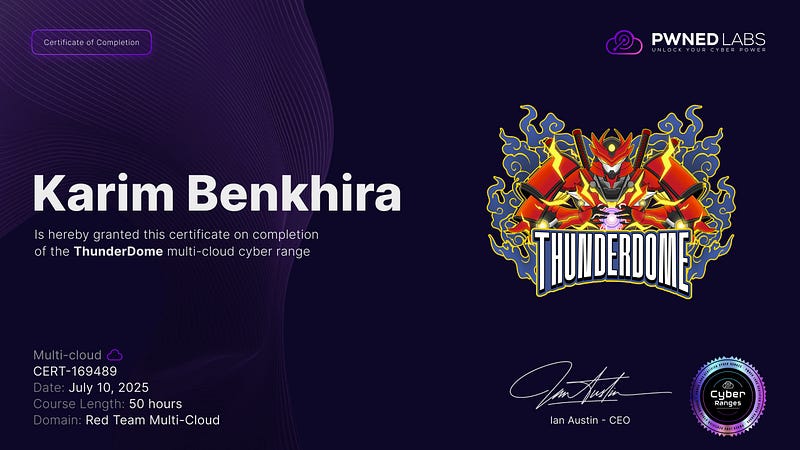
ThunderDome — Thinking across cloud boundaries
ThunderDome expanded the challenge across AWS, Azure, and GCP. It required me to adapt to different services and identity models while keeping the overall environment in view.
The most useful lesson was that multi-cloud security is not simply three separate assessments. Integrations and shared identity arrangements create relationships that need to be understood together.
Working through the range strengthened my ability to reason about credentials, tokens, and the boundaries between platforms. I could not assume that a technique or permission model from one provider translated directly to another.
Skills I strengthened
Technical practice
- Command-line confidence: using the AWS CLI, Azure CLI, and Google Cloud tooling across Windows and Linux.
- Cloud enumeration: organizing information about identities, resources, permissions, and relationships.
- Web-to-cloud reasoning: assessing how an application weakness might affect the surrounding cloud environment.
- Tool selection: choosing tools to answer a specific question rather than treating their output as a conclusion.
Methodology and judgment
- Threat modeling: identifying plausible attack paths and the assumptions behind them.
- Impact assessment: distinguishing an interesting configuration from a demonstrated security consequence.
- Detection awareness: understanding what activity defenders might observe, and how logging and monitoring affect that visibility.
- Clear documentation: preserving the reasoning behind a finding so someone else can review it.
Applying the lessons
These experiences gave me a stronger foundation for several kinds of security work:
- Cloud-focused red-team assessments: developing a structured approach to identity, permissions, and attack paths.
- Architecture reviews: examining trust boundaries before they become difficult-to-correct deployment assumptions.
- Incident response: recognizing how cloud identities and services can shape an intrusion.
- Security awareness: explaining why cloud configuration and credential handling matter to developers and operations teams.
These are areas where I want to apply the lessons—not a claim that completing training replaces experience in a production environment.
Lessons that stayed with me
Configuration matters
In these exercises, misconfigurations often mattered more than an unfamiliar exploit. IAM policy design, secure defaults, and regular posture reviews consistently deserved attention.
The practical takeaway was to look at how controls interact. A permission, trust relationship, or exposed service may be much more significant in combination than it appears on its own.
Visibility needs context
Logs are most useful when I understand the behavior I am trying to detect. The training reinforced the importance of appropriate logging coverage, behavioral analysis, and threat hunting informed by known attack patterns.
Learning from the attacker’s perspective helped me ask more useful defensive questions.
Defense needs multiple layers
No single control answered every problem. Identity boundaries, workload security, network restrictions, monitoring, and response all contributed to limiting an attack’s reach.
The more useful question became: if one boundary fails, what prevents the next step?
Looking forward
The combination of structured ACRTP training and hands-on cyber ranges worked well for me. It made cloud security less abstract and gave me a more disciplined way to connect technical observations to impact.
There is still more to learn. I want to continue improving how I assess cloud environments, explain attack paths, and connect offensive findings to practical defensive changes.
The central lesson is simple: effective cloud security requires understanding both how a system is intended to work and how its assumptions can be challenged.