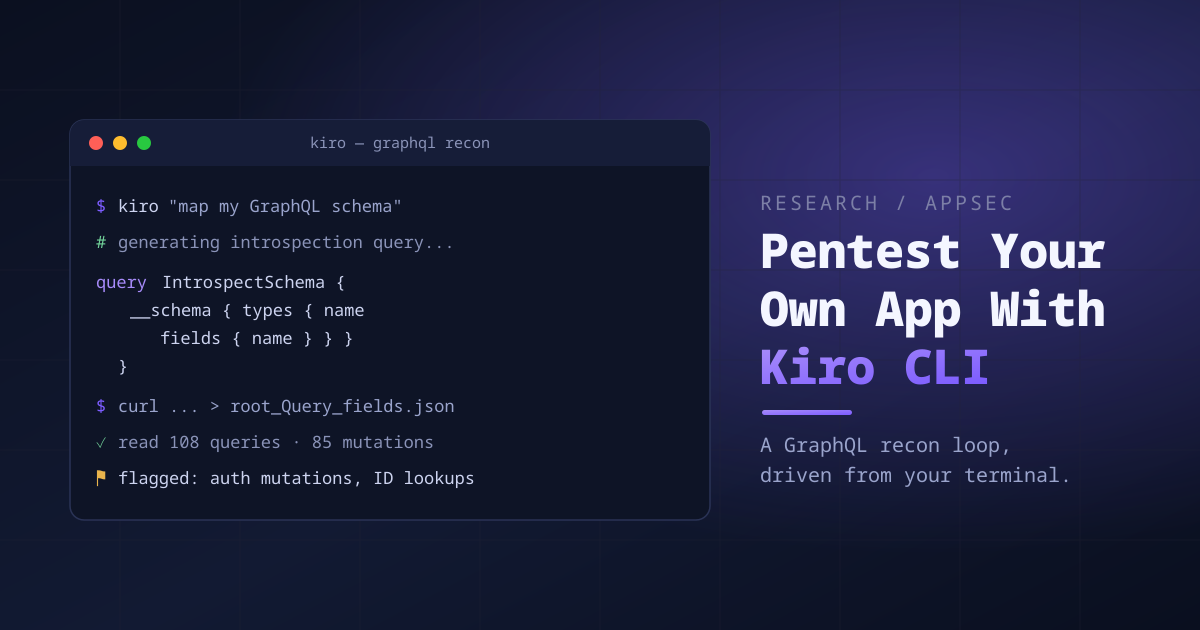
Here’s a defensive scenario. You’re responsible for your own app’s security. A red teamer’s first move against a GraphQL service is almost always introspection — mapping every query and mutation to find the one with a missing authorization check. The best defense is to run that same recon pass first, on your own schema, and close the gaps before an attacker ever sees them. You can’t defend an attack surface you haven’t mapped.
Kiro CLI is built for developers, but one underrated use is turning it on your own app: running that structured recon pass — the same way a tester would, but from the defender’s side — right inside your dev loop, before anything ships. This is the workflow I use to do exactly that for a GraphQL API, and why it’s worth adopting if you build on a GraphQL layer.
Who this is for: developers shipping GraphQL who want a lightweight security habit, not a full penetration test.
What you’ll need: Kiro CLI, a GraphQL endpoint you own or are authorized to test, and a way to send requests (curl, Postman, or your HTTP client of choice).
Why This Matters for Builders
If you’re building fast with Kiro, you’re probably moving just as fast on your API surface — new queries, new mutations, new resolvers landing with every feature. It’s easy to lose track of what’s actually exposed. GraphQL makes this worse: a single endpoint can quietly surface dozens of queries and mutations that were never meant to be public, or that were never given a proper authorization check.
Instead of waiting for a formal security review, you can let Kiro walk the schema with you — enumerating what’s there, flagging what looks risky, and catching issues early while they’re still cheap to fix.
The Workflow
The idea is simple: Kiro writes the recon queries, you run them, and Kiro reads the real responses back. You stay in control of what actually touches your API, while Kiro does the schema-reading and prioritization.
1. Ask Kiro to generate a starting query.
For GraphQL, that’s introspection — enumerating your schema’s queries and mutations. Kiro wrote the curl payloads for me:
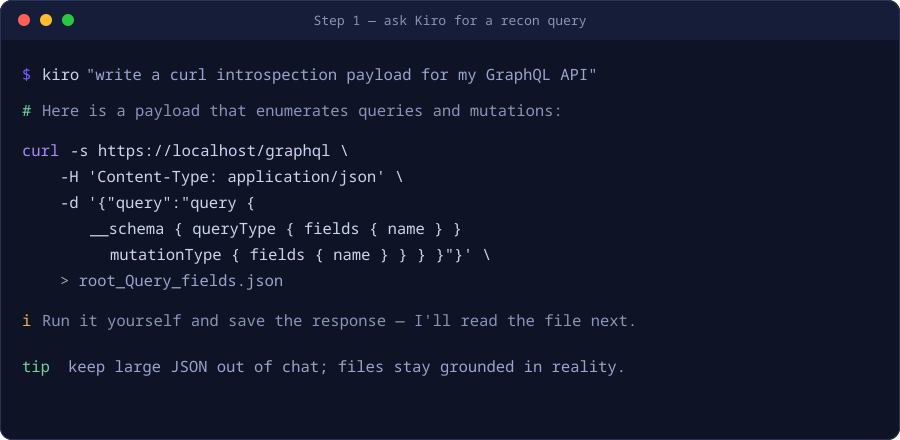
2. Run it yourself and save the response to a file.
Rather than pasting large JSON blobs into chat, I ran the curl commands and saved the output to files like root_Query_fields.json and root_Mutation_fields.json.
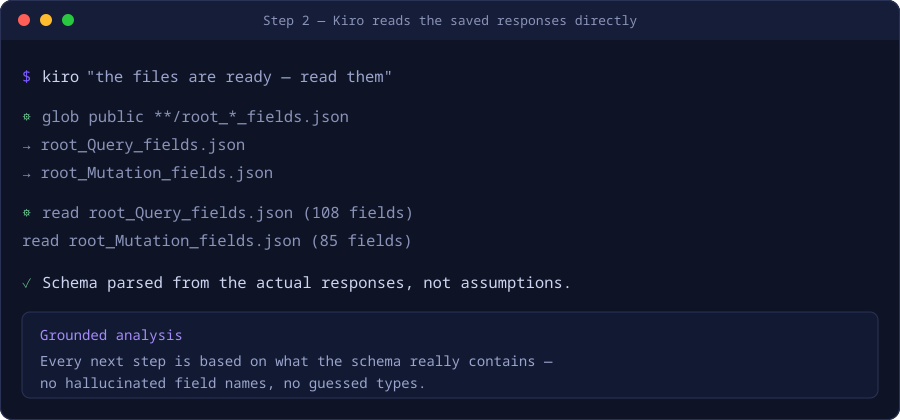
3. Tell Kiro the files are ready — it reads them directly.
Kiro used its file tools (glob + read) to pull in both files and parse the full schema:
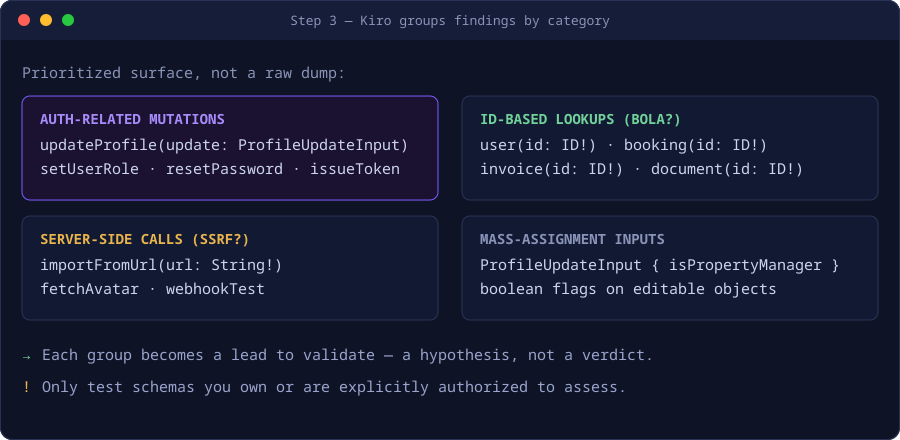
4. Kiro analyzes the schema and flags what’s worth a closer look.
Instead of just dumping the schema back at me, it grouped findings by category — auth-related mutations, ID-based lookups that could hint at object-level authorization issues, server-side calls worth tracing:
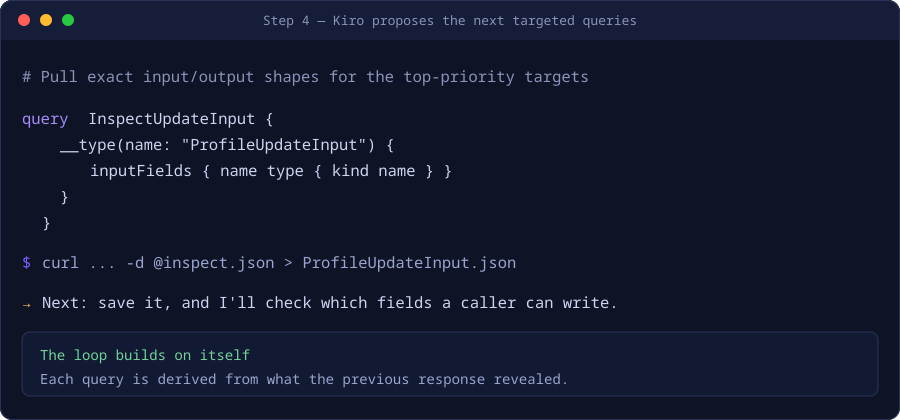
5. It proposes the next targeted queries, building on what it just learned.
Based on the flagged fields, Kiro generated follow-up introspection payloads to pull the exact input/output shapes for the highest-priority targets:
6. Repeat the loop.
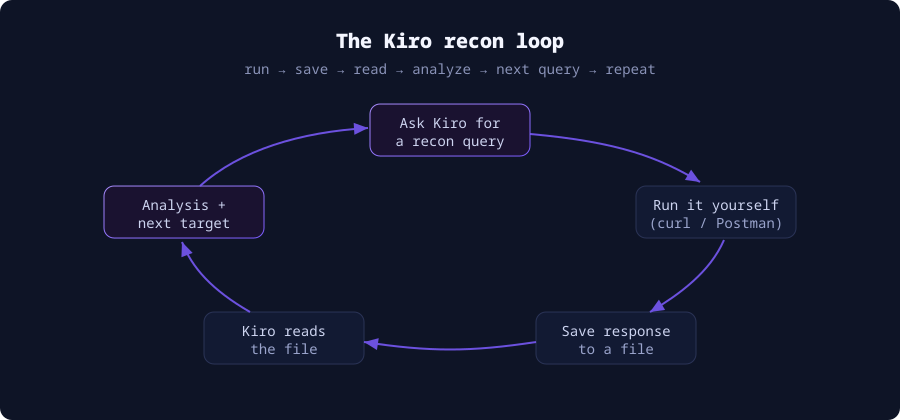
Run → save → let Kiro read → get analysis → get the next query — until the schema is fully mapped.
What You Actually Get Out of It
- A fast, structured map of your own schema — much quicker than manually cross-referencing types and fields by hand.
- Prioritized findings, not just a raw dump — Kiro highlights what looks worth testing further, based on naming, argument types, and descriptions.
- A repeatable habit you can run every time you add new queries/mutations, instead of a one-off audit that goes stale.
- Grounded analysis — because Kiro reads the actual saved responses instead of guessing, each next step is based on what your schema really looks like, not assumptions.
The Pattern, Simplified
1. Ask Kiro for a recon query against your API
2. Run it yourself (curl, Postman, etc.)
3. Save the response to a file
4. Tell Kiro to read it
5. Get analysis + the next targeted query
6. Repeat until the schema is covered
Takeaway
You don’t need a separate tool to start catching common GraphQL issues like broken object-level authorization or over-exposed mutations. Point Kiro at your own schema, let it drive the recon loop, and fix what it flags before it ships.
Think of it less as a one-off audit and more as a habit: run the loop each time you add queries or mutations, and your view of the attack surface never goes stale. That’s the kind of lightweight, repeatable security work that actually sticks — because it fits inside the dev loop you’re already in.